Datarails vs. Anaplan

Anaplan promises connected planning. Disconnected from your timeline and your budget.

Implementing Anaplan is an 18-month project, a consulting dependency, and a budget commitment most mid-market finance teams can't justify.


See Datarails in Action

By submitting this form, you are agreeing to receive communications from Datarails. More information can be viewed in our Privacy policy.

Trusted by finance teams Join 1000+ FP&A teams already using Datarails
Capability
Datarails
Anaplan_logo.svg
Target Market
Mid-market and scaling organizations
Large enterprise, multinational environments
Architecture
Relational model. Add dimensions, entities, or data sources without rebuilding models.
Proprietary Hyperblock engine. Every structural change requires certified model builders.
No-code agility
Adapt models and workflows without system configuration
Structural changes require consultant involvement
Implementation timeline
6-12 weeks, fully in-house. No partner required.
Up to 18 months, always partner-driven
Excel experience
Fully connected, bidirectional Excel integration
Excel abandoned entirely, proprietary interface required
Cost profile
All-inclusive pricing. No consulting fees or hidden implementation costs
Premium enterprise investment plus implementation fees that compound significantly
AI-ready data layer
Governed financial data layer, reconciled and traceable to every source transaction
AI outputs locked inside Anaplan's architecture, difficult to export or connect to external tools
Support
100% in-house FP&A experts included in subscription
Partner ecosystem and Center of Excellence dependent
Scalability
Built for mid-market to enterprise, scales without replatforming
Built for Fortune 500 complexity, disproportionate for mid-market requirements

Take a 2-minute self-guided tour

Anaplan costs what it costs. The question is whether you get what you pay for.

Anaplan promises connected planning across the enterprise. What it delivers is an 18-month implementation, a proprietary interface that replaces Excel, and a total cost of ownership that most mid-market finance teams can't justify.

The platform is genuinely powerful for Fortune 500 enterprises with dedicated model builders, IT support, and multi-year implementation budgets. For everyone else, the gap between what Anaplan promises and what it costs to operate is where they fail to deliver.

If you need enterprise-grade finance without the overhead, the consulting dependency, or the 18-month runway, Datarails is the more practical path.

Anaplan's weight works against you

book-open-text 1-1

Implementation stretches into quarters

Anaplan implementations are partner-driven by design. Timelines typically run 6-18 months, with some deployments stretching further as scope expands and customizations compound. The platform demands significant technical expertise, making it unsuitable for lean finance teams without dedicated IT support. Three to five year commitments are standard, meaning teams that struggle to deploy are locked in long after the budget cycle they were supposed to support has passed.

expert-1

Mastery requires months, not days

Anaplan's learning curve is steep by design. Training materials require 60+ hours before users reach basic proficiency. The codebase is hard to master. Uploading changes is difficult and time consuming, iterative calculations are unsupported, and navigating someone else's model structure demands ongoing specialist involvement. Non-technical users consistently struggle, and adoption suffers. Finance teams that expected to own the platform often find themselves dependent on the people who built it.

Planning-1

AI portfolio lags behind

Anaplan's AI portfolio: Forecaster, CoModeler, and role-based planning agents run inside Anaplan's proprietary environment. There is no open data layer, no lineage back to source transactions, and no governed multi-source foundation for AI to work from. Users consistently note that AI features are not deeply embedded in day-to-day workflows. For finance teams where AI-driven insight is a requirement today, Anaplan's closed architecture is a meaningful constraint.

Implementation-1

Integration gaps slow everything down

 Anaplan has no native ETL capability; without a dedicated integration tool, users resort to manually uploading CSVs to move data into the platform. Integration support is limited, event workflow range is narrow, and iterative calculations are unsupported. For finance teams expecting seamless connectivity across ERP, CRM, payroll, and operational data, Anaplan's data pipeline requires significant additional investment to function at scale. 

Enterprise

Add-on costs compound after signing

Anaplan figures only emerge after a sales engagement. The base license starts around $100k annually, with Data Orchestrator adding roughly $200k and the sparsity engine $350k+ per year. Implementation alone can reach $100k for a single engagement. Three to five year commitments are standard, and app upgrades force costly rebuilds every time the business needs to adapt. Teams that struggle with deployment have reported waiting out contracts after the product became non-functional — with no refund offered. 

Support-1

Excel still fills the gaps

Finance teams still export data into spreadsheets to complete modeling or analysis before re-uploading results into Anaplan. Basic charting capabilities leave users wanting more when communicating insights. The platform's strength lies in its calculation engine, not its visualization tools. When the platform can't handle real finance logic or produce board-ready outputs, Excel fills the gap.

Datarails: Enterprise-grade finance without the overhead

Full consolidation without the bespoke build

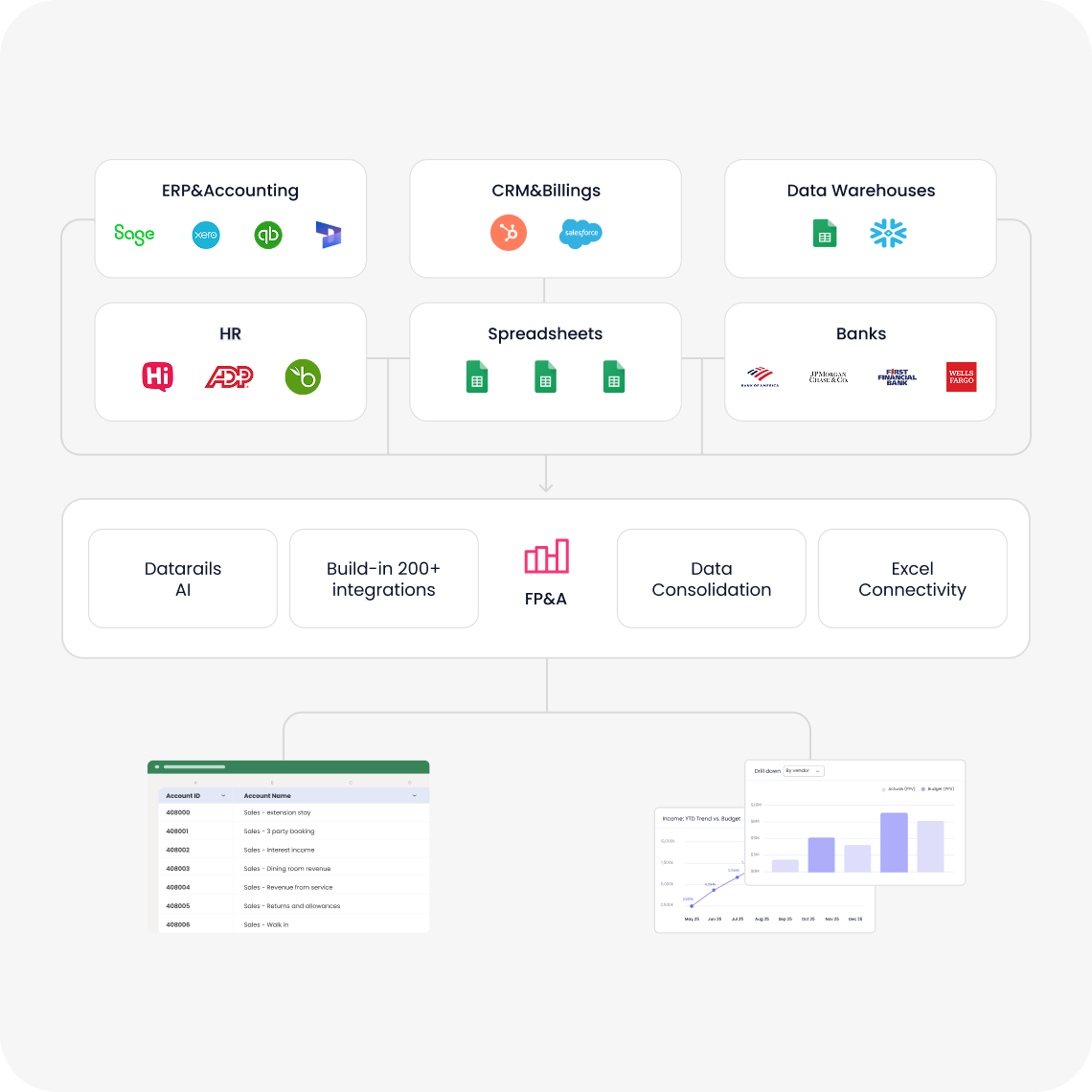
Consolidation shouldn't require a months-long configuration project. Datarails delivers multi-entity consolidation with eliminations, FX translation, and audit trails out of the box, connected across 600+ systems. Finance goes live in weeks, not quarters.

Keep Excel. Gain everything else.

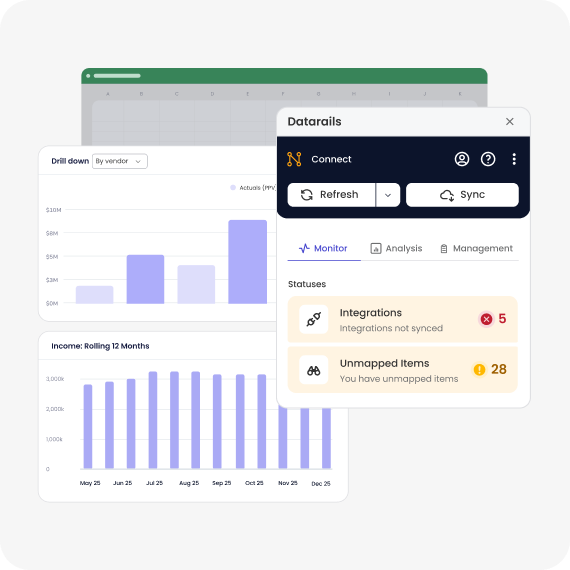
Finance keeps existing models, formulas, and workflows while gaining automation, version control, governance, and real-time dashboards. No rebuild of years of spreadsheet logic. No retraining the team. No dedicated system administration function.

Adapt without waiting on consultants

Datarails is built for finance teams that want to own their models, update their structures, and iterate their forecasts without raising a support ticket or waiting on external configuration. Agility is built in, not bolted on.

Implement in weeks, not months

OneStream implementations are measured in months. Datarails implementations are measured in weeks. Setup, onboarding, and support are included in the subscription. Budget season doesn't have to wait for system configuration.

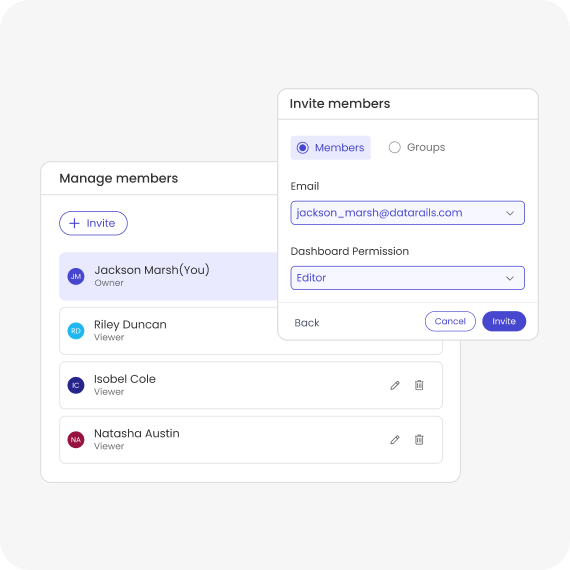
Align teams with collaborative workflows

Assign and manage tasks, collaborate across departments, and keep your team aligned with structured workflows. Use Excel Online for real-time collaboration so everyone works from the latest numbers throughout the forecasting cycle.
Eliminate manual forecasting
Single source of truth
Model scenarios
Forecasting models
Collaborative workflows

Learn why finance teams choose Datarails

G2BestSoftware2026-Badge-Persona-AccountingFinance Badge Badge Badge Badge capterra shortlist 2026 2a342f76-15b8-465c-8cea-0dccab62c157 (3) 90c31432-a1f3-47f6-81a8-5440f506d8ee (2)

Don’t just take our word for it

FAQ

The implementation timeline, consultant dependency, and total cost of Anaplan are significant factors. Teams that need consolidation and FP&A depth without an 18-month deployment and ongoing administrative overhead consistently find Datarails the more practical path.

Yes, and many customers do this for 1-2 cycles to ensure continuity. We’ll work with your team to create a phased migration plan that minimizes risk.

Nope. Datarails works natively with Excel, so your existing models can be imported and enhanced with version control and workflows.

Anaplan has a steep learning curve by design — it's an enterprise system that requires enterprise-level technical management. Datarails has one requirement: knowing Excel. Finance owns it from day one without IT involvement, consultant support, or a dedicated admin function.

Datarails consolidates across 600+ systems with eliminations, FX translation, and audit trails built in. Adding an entity doesn't require a consultant. Updating a structure doesn't require a support ticket. Finance owns consolidation completely, from setup to close.

Configurability and agility are different things. Anaplan's bespoke build means every structural change requires specialist involvement. Datarails lets finance teams adapt models, update structures, and iterate forecasts without raising a support ticket or waiting on external configuration.

Ready to leave Anaplan behind?

Join 1,000+ finance teams who switched to Datarails for version control, workflow automation, and professional-grade visualizations.