Abacum demos well. But a sleek interface doesn't run consolidations, forecast cash, or connect your AI to governed financial data.
As finance teams scale, the limits of a web-based planning layer show fast - modeling narrows, cash visibility lags, and close still lives somewhere else.
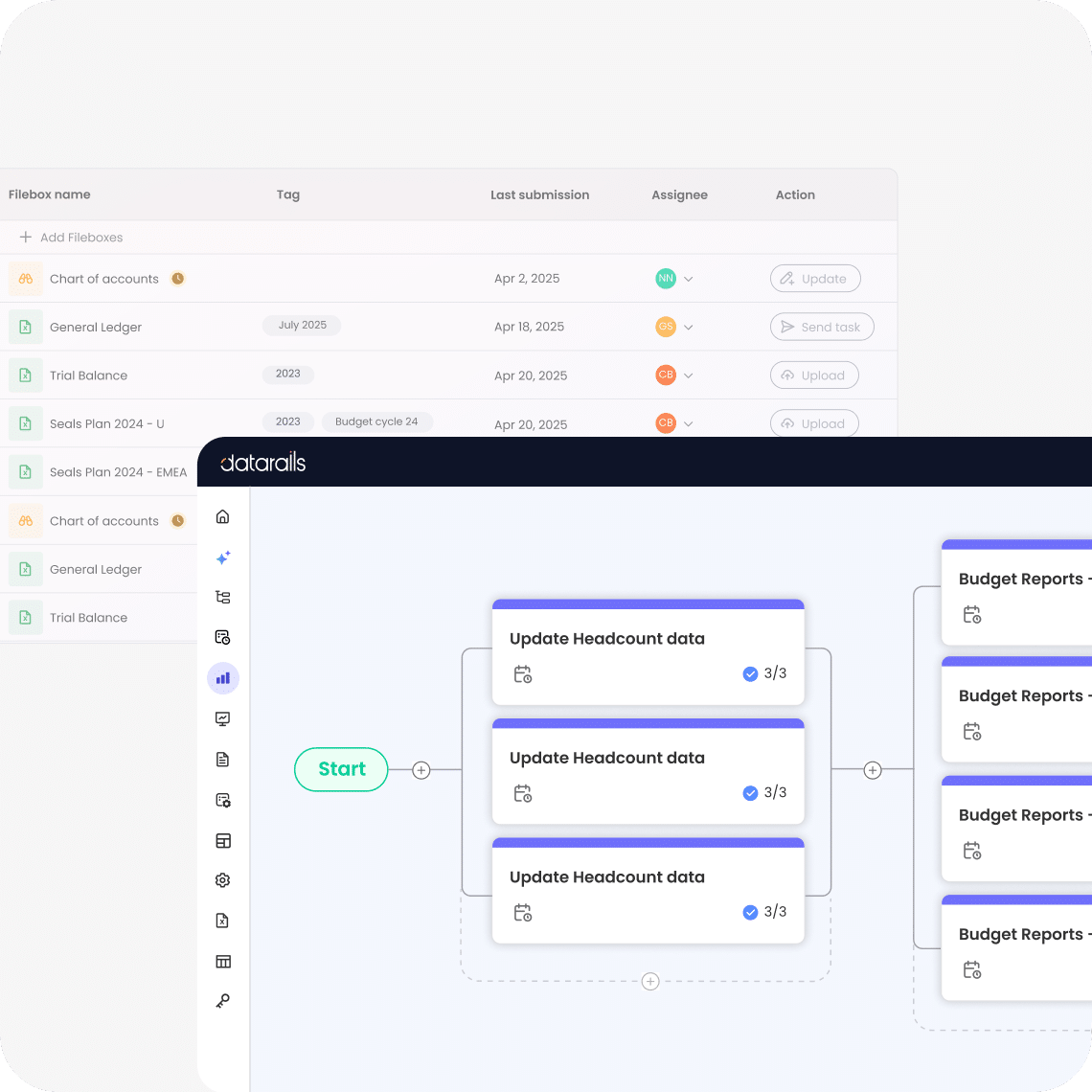
Datarails covers the full CFO mandate: close, consolidation, cash management, and FP&A on one unified data layer - native in Excel, with AI that works on numbers you can defend.
Join thousands of FP&A teams already using Datarails

Abacum is built around planning workflows. Everything outside that - close, consolidation, cash visibility, and connecting your data to AI - depends on other systems, manual exports, and coordination overhead that Abacum doesn't solve.
The result is a finance team that looks modern on the surface but is still stitching together the actual work in the background. A planning layer is not a finance platform.
Abacum's AI runs on data loaded into Abacum. It has no visibility into your ERP actuals, your CRM pipeline, or your HRIS headcount unless you've manually imported it - and even then, there's no lineage. When your CFO asks why a number moved, Abacum's AI can't trace it back to a source transaction. Datarails consolidates your data from every system first, then lets any AI tool - Claude, ChatGPT, or whichever you use - run on numbers that are reconciled, finance-adjusted, and auditable.
Modern FP&A requires continuous, rolling forecasts. Abacum centers around standard planning cycles, with no weekly forecasting capability. Finance cannot update projections dynamically, slowing responsiveness to changing business conditions and reducing forecast accuracy.
Abacum relies on predefined modeling structures that work best for highly standardized planning. As organizations grow and complexity increases across entities, departments, and drivers, Abacum struggles with maintaining accurate models. Finance teams must adapt to platform constraints instead of modeling the business as it operates.
Abacum’s Excel add-in primarily pulls data into spreadsheets, but does not support full model ownership. Write back is limited, and finance teams cannot freely manage complex, multi-sheet logic from Excel. Access to underlying data is restricted, and the inability to drill down into granular data creates unnecessary friction for teams that need insights quickly.
Abacum does not provide native bank integrations or a true rolling 13-week cash flow framework. Cash projections depend on ERP refresh cycles or manual uploads, reducing real-time visibility into liquidity and limiting proactive cash management.
Moving to Abacum requires rebuilding models, workflows, and reporting logic inside a closed environment. Teams must learn platform-specific syntax, creating significant upfront migration effort, and often rely on specialized consultants to maintain core logic. Finance loses autonomy and increases costs.
“I think choosing Datarails was the greatest decision ever for our company.”
“Thank goodness we went with Datarails, because there’s no way we’d be where we are as a team.”
“Datarails gives us a single source of truth. That kind of visibility changes everything.”
Abacum is built around planning workflows and a clean web interface. Datarails is built around how finance actually operates — close, consolidation, cash management, and FP&A unified on a single data model inside Excel. Teams choose Datarails when they need more than a planning layer: real consolidation, real cash visibility, and a platform that covers the full CFO mandate without stitching together separate systems.
Yes, and many customers do this for 1-2 cycles to ensure continuity. We’ll work with your team to create a phased migration plan that minimizes risk.
No. Because Datarails works natively with Excel, your existing models, logic, and formulas carry over directly. There's no need to recreate work inside a proprietary environment or learn a new modeling syntax. Your institutional knowledge stays intact and enhanced with version control and workflows.
Abacum has a steep learning curve by design — it's a web-based planning system that requires proprietary syntax. Datarails has one requirement: knowing Excel. Finance owns it from day one without IT involvement, consultant support, or a dedicated admin function.
Abacum's polished web interface comes at the expense of planning flexibility. Datarails is designed around how finance teams actually work — not inside a browser tab. For most finance teams, working natively in Excel with full model ownership and real-time data is a better experience than waiting on support to reconfigure every change. And for reporting and board-ready outputs, Datarails delivers professional-grade visualizations without the manual rebuild.
Join 1,000+ finance teams who switched to Datarails for version control, workflow automation, and professional-grade visualizations.