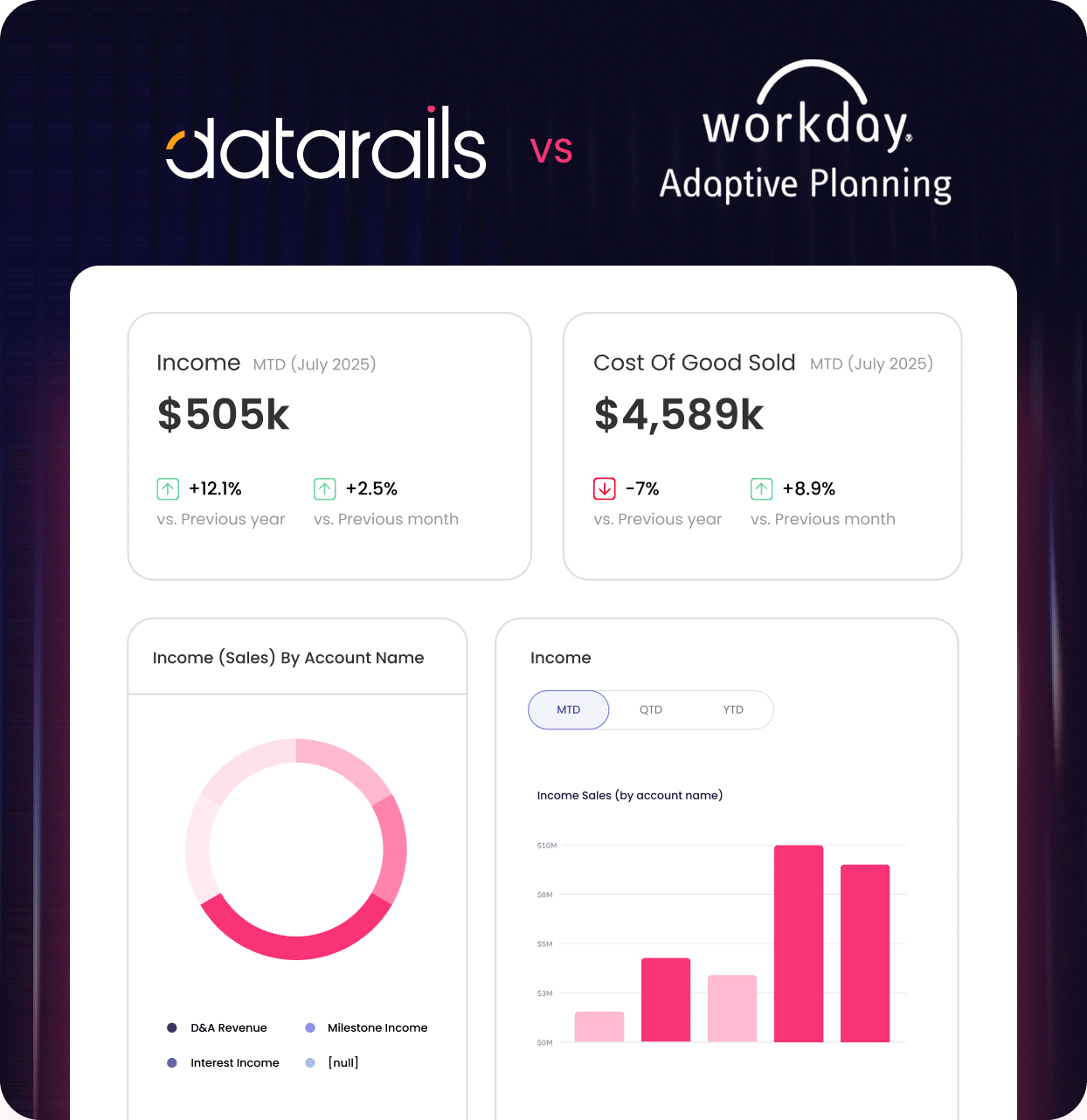
Datarails vs. Adaptive Planning

Finance teams choose Datarails.
IT departments choose Adaptive.

Adaptive is established and widely used—but that comes with rigidity, partner dependence, and enterprise complexity. Adaptive’s focus shifted from FP&A innovation to cross-selling HR solutions. What’s left? A roadmap that doesn’t prioritize your needs. Datarails is purpose-built for finance teams who want true ownership without the enterprise complexity.

See Datarails in Action

Trusted by finance teams Join thousands of FP&A teams already using Datarails
Capability
datarails dark logo-1
Workday_Logo
Primary Focus
FP&A with Excel integration and a multi-product approach for the office of the CFO
Cloud-based CPM and business intelligence /HR cross-sell and Workday ecosystem integration
Target Market
Small to mid-size finance teams
Mid-market to enterprise organizations
Excel Integration
Deep native Excel-based workflow
Mostly web-based, limited Excel functionality
Self-Service
Full control to build tables, add entities
Requires support/partner for basic changes
Implementation
4-6 weeks, in-house experts
6-9 months, 100% partner-led
Learning Curve
Lower (familiar Excel interface)
Steeper (proprietary interface)
Pricing Model
All-inclusive pricing. More affordable for SMBs
Higher price point, paid add-ons, enterprise focus
Support
100% in-house FP&A experts
Basic bugs only; training requires paid partners
Roadmap Priority
Finance-first features
Workday ecosystem add-ons (less than 1% of Workday revenue)

The hidden costs

Adaptive has been around since 2003—and yes, that gives them brand recognition and a large customer base. But longevity doesn’t equal the right fit for your team. Adaptive was built for Workday ERP customers and thrives in enterprise environments with dedicated IT support and unlimited budgets. If you’re an Excel-centric finance team looking for flexibility and true ownership, Adaptive will slow you down and cost you more than you planned.

What you’re missing out on

Frame-1437253982-1

Built for Finance teams, not IT departments

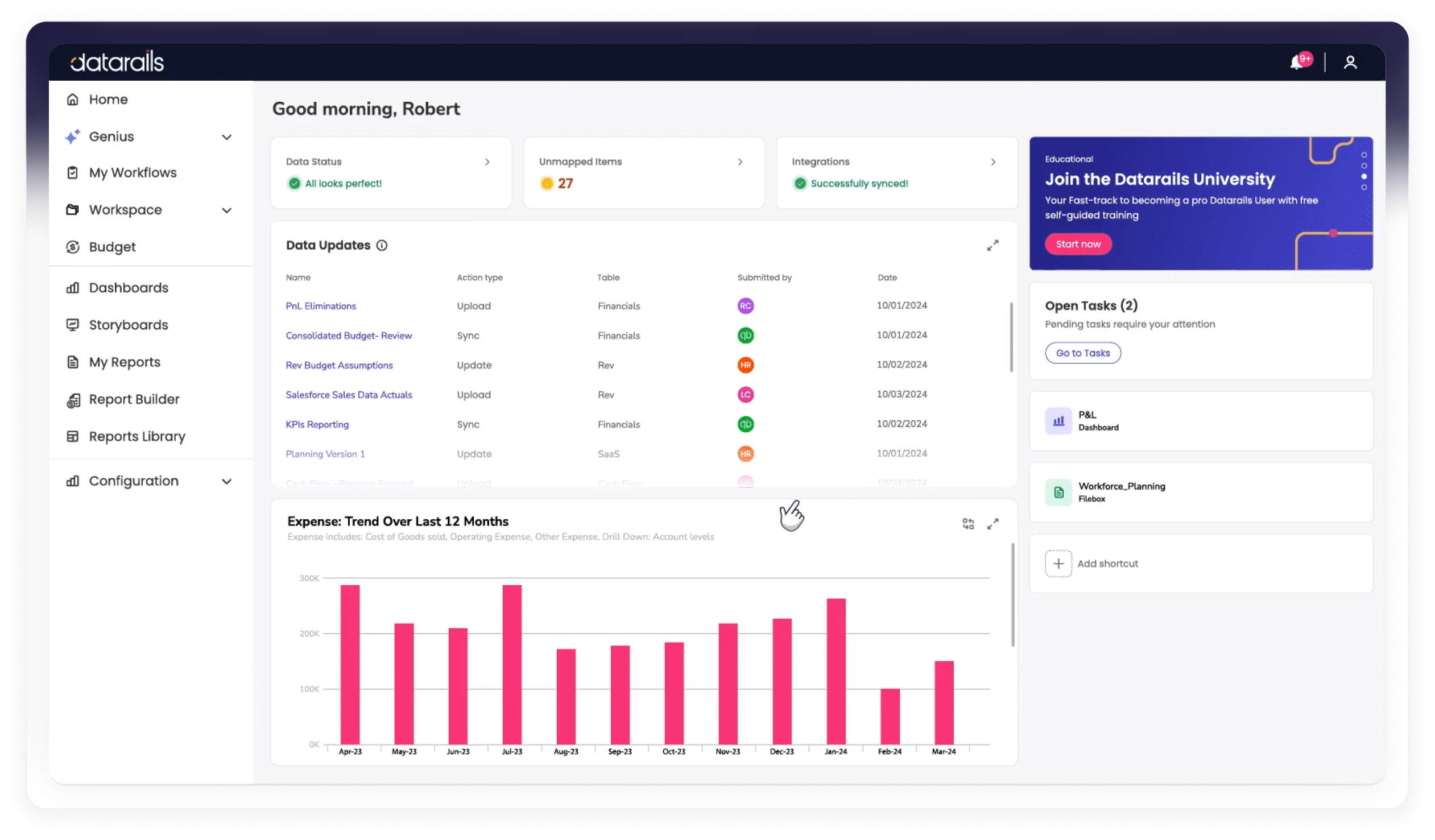
Adaptive’s proprietary interface requires a steep learning curve and heavy IT involvement. Your finance team will need dedicated training, ongoing technical support, and likely a consultant on retainer. Datarails works directly in Excel—the tool your team already knows, and loves—with enterprise automated controls layered on top.

Frame-1437253983

Self-service vs partner-led

Every Adaptive implementation is partner-led, which means inconsistent outcomes, inflated costs (implementation alone can exceed software costs), and dependency on external consultants for changes. Datarails implementations are done in-house by our FP&A experts, giving you direct access to the people who understand finance workflows.

Frame-1437253983-1

Templates that flex, not break

Adaptive’s rigid templates look impressive in demos but become expensive bottlenecks when your business evolves. Customization requires coding and partner support. Datarails preserves your existing Excel models and workflows, giving you the flexibility to adapt without breaking your budget or your processes.
Frame-1437253983-1-1

Excel functionality that’s stuck in 2011

Adaptive offers limited Excel connectivity—it’s a cloud platform first, Excel second. For Excel-native finance teams, this creates friction and forces you to change how you work. Datarails is built around Excel, letting you keep your familiar workflows while adding automation, version control, and collaboration capabilities.

Frame-1437253983-2 (1)

Roadmap built for Finance, not workday customers

After acquisition, Workday spent years just connecting Adaptive’s backend to their systems, severely limiting innovation. The roadmap now focuses on Workday ecosystem integration, not FP&A advancement. Datarails’ roadmap is built by finance people, for finance people, with features customers actually use.

Frame-1437253983-3

Transparent pricing without any surprises

Adaptive’s upfront pricing can very quickly lead to surprises due to implementation and professional services fees, often doubling your initial investment. Datarails offers predictable, transparent pricing with implementation and premium support included. No surprises, ever.

Datarails: Excel-native FP&A without the Workday price tag

Self-service vs partner-led

Every Adaptive implementation is partner-led, which means inconsistent outcomes, inflated costs (implementation alone can exceed software costs), and dependency on external consultants for changes. Datarails implementations are done in-house by our FP&A experts, giving you direct access to the people who understand finance workflows.

Templates that flex, not break

Adaptive's rigid templates look impressive in demos but become expensive bottlenecks when your business evolves. Customization requires coding and partner support. Datarails preserves your existing Excel models and workflows, giving you the flexibility to adapt without breaking your budget or your processes.

Excel functionality that's stuck in 2011

Adaptive offers limited Excel connectivity—it's a cloud platform first, Excel second. For Excel-native finance teams, this creates friction and forces you to change how you work. Datarails is built around Excel, letting you keep your familiar workflows while adding automation, version control, and collaboration capabilities.

Roadmap built for Finance, not workday customers

After acquisition, Workday spent years just connecting Adaptive's backend to their systems, severely limiting innovation. The roadmap now focuses on Workday ecosystem integration, not FP&A advancement. Datarails' roadmap is built by finance people, for finance people, with features customers actually use.
Datarails@2x-2
Frame-1437254026@2x
Connect-8 (1)
Group-1410115999

Learn why finance teams choose Datarails

Badge Badge Badge Badge

Don’t just take our word for it

“Without Datarails, I would’ve needed to double my current team of three just to produce what we’re delivering today”

Steven Carkey VP Finance Operations, 100%
100logo_2021-01-22-10-57-34-1

“Thank goodness we went with Datarails, because there’s no way we’d be where we are as a team.”

Charlotte Kelly Head of FP&A, Butternut Box

“Datarails gives us a single source of truth. That kind of visibility changes everything.”

John Smith CFO, CDG

FAQ

It shouldn't, but it does. Adaptive's roadmap heavily favors Workday ERP customers. Users users often find themselves waiting for integrations and features that aren't prioritized.

Adaptive is cloud-first with limited Excel integration. If your finance team is Excel-native, you'll face a steep learning curve and workflow disruption. Datarails works directly in Excel while adding enterprise-grade automation, version control, and collaboration.

Absolutely. We've helped several teams transition from Adaptive to Datarails. Most migrations happen with minimal disruption to your FP&A processes.

Datarails is built to grow with you—from small finance teams to mid-market and enterprise organizations. We handle complex consolidation, multi-currency, intercompany eliminations, and hierarchical structures. The difference? You can scale without needing a dedicated IT team or partner consultants.

Datarails' support is 100% in-house with FP&A experts who understand finance workflows, not just technical issues. You get direct access to our team for both product and process questions—no middleman partners. 

Answer text Adaptive has history, but that comes with legacy complexity and partner reliance. Being "established" doesn't mean it's the right fit for Excel-centric finance teams at organizations who need flexibility for custom models. Datarails is purpose-built for finance to own and operate without needing IT or costly consultants. Longevity doesn't equal the best solution for your needs.
.

Ready to leave Adaptive behind?

Join 1,000+ finance teams who switched to Datarails for version control, workflow automation, and professional-grade visualizations.